By BuntsFootprints.com Editorial Team
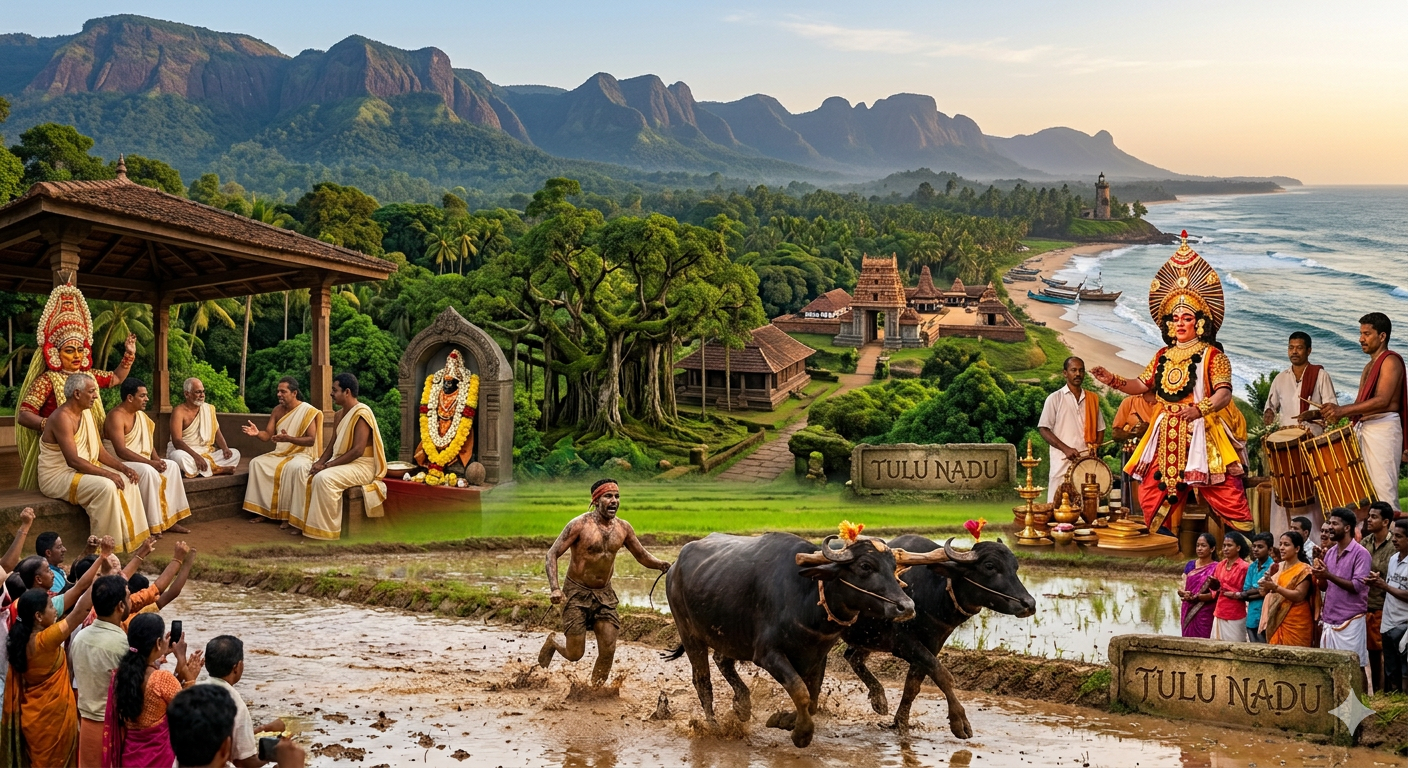
There is a stretch of land along India’s southwestern coast where the Western Ghats tumble dramatically toward the Arabian Sea — lush, green, and ancient beyond measure. This is Tulu Nadu. And for well over a thousand years, it has been home to one of South India’s most storied communities: the Bunts.
Theirs is not a quiet history. It is a history of warriors who became kings, kings who became empire builders, and a people who — centuries later — carry their remarkable heritage proudly across every corner of the world.
A Name That Says Everything
Start with the name itself, because it tells you everything you need to know.
The word Bunt traces back to the Sanskrit Bhata — meaning powerful man, soldier, protector. In the Tulu language spoken along the Karnataka coast, the community is also called Nayaka(leader), Shetray (nobility), and Nadava (owner of the land). These were not titles given by others. They were names earned — through service, through sacrifice, and through centuries of building something worth protecting.
Where Did the Bunts Come From?
This is the question that has fascinated historians for generations, and the honest answer is: nobody knows for certain — which makes it all the more interesting.
One compelling theory traces Bunt ancestry to the Koshar people, a sophisticated civilisation that flourished in the Sindh River Valley around 2500 BC during the era of the Harappa Civilisation. According to this theory, they migrated south along the coastal sea route following the Aryan invasion, eventually settling along the Karnataka coast and establishing the foundations of what would become one of the region’s most powerful communities.
What is not disputed is this: the Bunts have been the backbone of Tulu Nadu for at least two thousand years. Their earliest recorded mention appears in a 9th century inscription from Udyavara, near present-day Udupi — twelve centuries of documented history, and counting. Their lineage is traced to the ancient Alupa dynasty, the original ruling family of coastal Karnataka, whose influence over the region stretched from roughly the 2nd century CE to the 15th century.
These were not outsiders who arrived and conquered. They were the land itself.
The Warrior Class That Shaped a Coastline
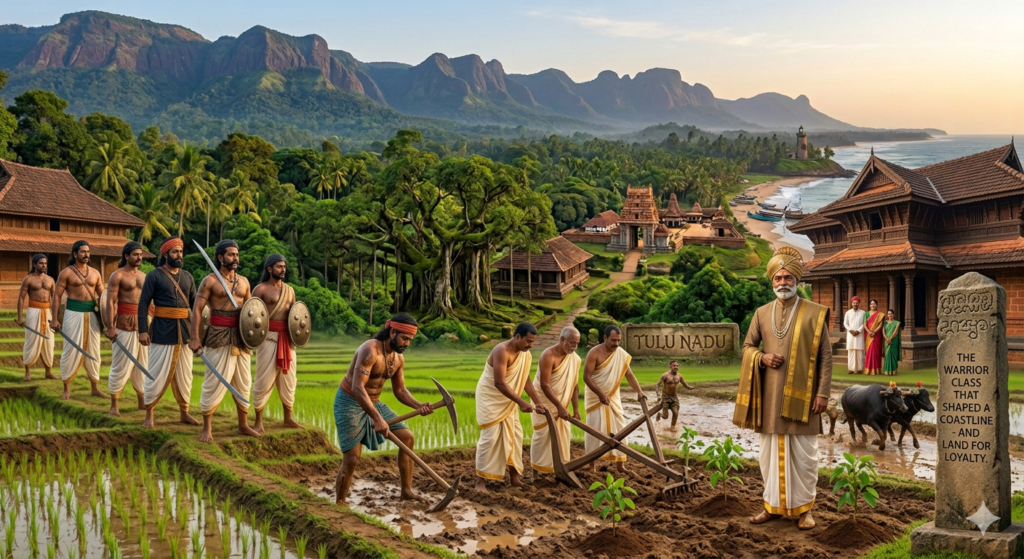
At their core, the Bunts were a martial community — a warrior class whose skill and loyalty to the ruling chiefs earned them something that outlasted every battle: land. Vast, fertile, rice-growing land stretching between the mountains and the sea.
Over time, the sword gave way to the plough. Warriors became farmers. Farmers became the landed gentry. And the landed gentry built the social, economic, and cultural architecture of Tulu Nadu that still stands today.
Their greatest moment in history, however, was yet to come.
The Empire Builders of the 16th Century
If there is one chapter of Bunt history that deserves to be told with particular pride, it is the 16th century and the rise of the Vijayanagara Empire — one of the most powerful empires in all of Indian history.
Scholars have long suggested that the Tuluva dynasty, which rose to control the Vijayanagara Empire with its capital at the magnificent Hampi, was of Bunt origin. The empire stretched across the entire south of India, and under its rule, Tulu Nadu flourished. The beautiful temples of Barkur that still stand today are not just architecture — they are the fingerprints of a community at the height of its power.
After the empire’s eventual decline, the Bunts returned their focus to Tulu Nadu, continuing as administrators, warriors, and landowners across generations of Hindu and Jain kingdoms that governed the coast.
A Society Built Around Women

Here is something that often surprises people unfamiliar with Bunt culture: for centuries, this warrior community built its social order around the mother.
The Bunts follow Aliyasantana — a matrilineal system of inheritance where lineage, land, and family name pass through the mother’s line. The community is organised into 53 matrilineal clans called Bari, with 93 distinct clan names and surnames. Members of the same Bari do not intermarry — a sophisticated social structure designed to preserve both family identity and community cohesion.
In a world still debating gender equality, the Bunts built maternal lineage into the very foundation of their society long before it was fashionable. That is worth pausing on.
From the Coast to the World
The 20th century brought profound disruption. Land reform laws in 1960s Karnataka fundamentally altered the economic landscape for Bunt families, and what could have broken a community instead unleashed it.
Faced with the loss of ancestral land, Bunts did what warriors have always done — they adapted. They moved to Mumbai, Bangalore, and beyond. They entered banking, hospitality, business, government service. They built new empires with education and enterprise instead of land.
Today, the global Bunt population is estimated at 1.2 to 1.3 million. From the UK to the United States, the Gulf to Australia — Bunts have carried the culture, warmth, and fierce pride of Tulu Nadu with them wherever they have settled. The diaspora is not a footnote to Bunt history. It is its newest, most dynamic chapter.
A Community That Invests in Itself
In 1908, community leaders in Mangalore established the Buntara Yane Nadavara Mathr Sangha — an apex body that has spent over a century running schools, colleges, hostels, and medical dispensaries across the region. A warrior community that builds hospitals and schools is a community that understands true strength.
That investment in collective progress continues through Bunt Sanghas and associations active across the globe today — quietly, steadily, ensuring the next generation knows who they are and where they come from.
The Footprints Continue
There is a reason this website is called BuntsFootprints.
Every family name. Every Bari. Every elder who remembers the old Tulu Nadu and every young person discovering their heritage for the first time — together, they are the ongoing story of a community that has never stood still.
Warriors. Protectors. Landowners. Pioneers
This is who we are.
.
Do you have a family story, a memory, or a piece of Bunt history worth preserving? We would love to hear from you. Reach us through our Contact page.
Leave a Reply